
African Art
All original works are oil on a canvas surface. You can purchase an original oil on canvas artwork or a large, or a medium limited edition print.
To begin your purchase please CLICK on the Artwork of your choice.
If you wish to discuss any of Colleen’s artworks please contact her at colleen@colleeno-artist.com
Colleen is always happy to discuss her work, or the purchase of any of her works with you.
For Shipping Destinations and Delivery Costs click here
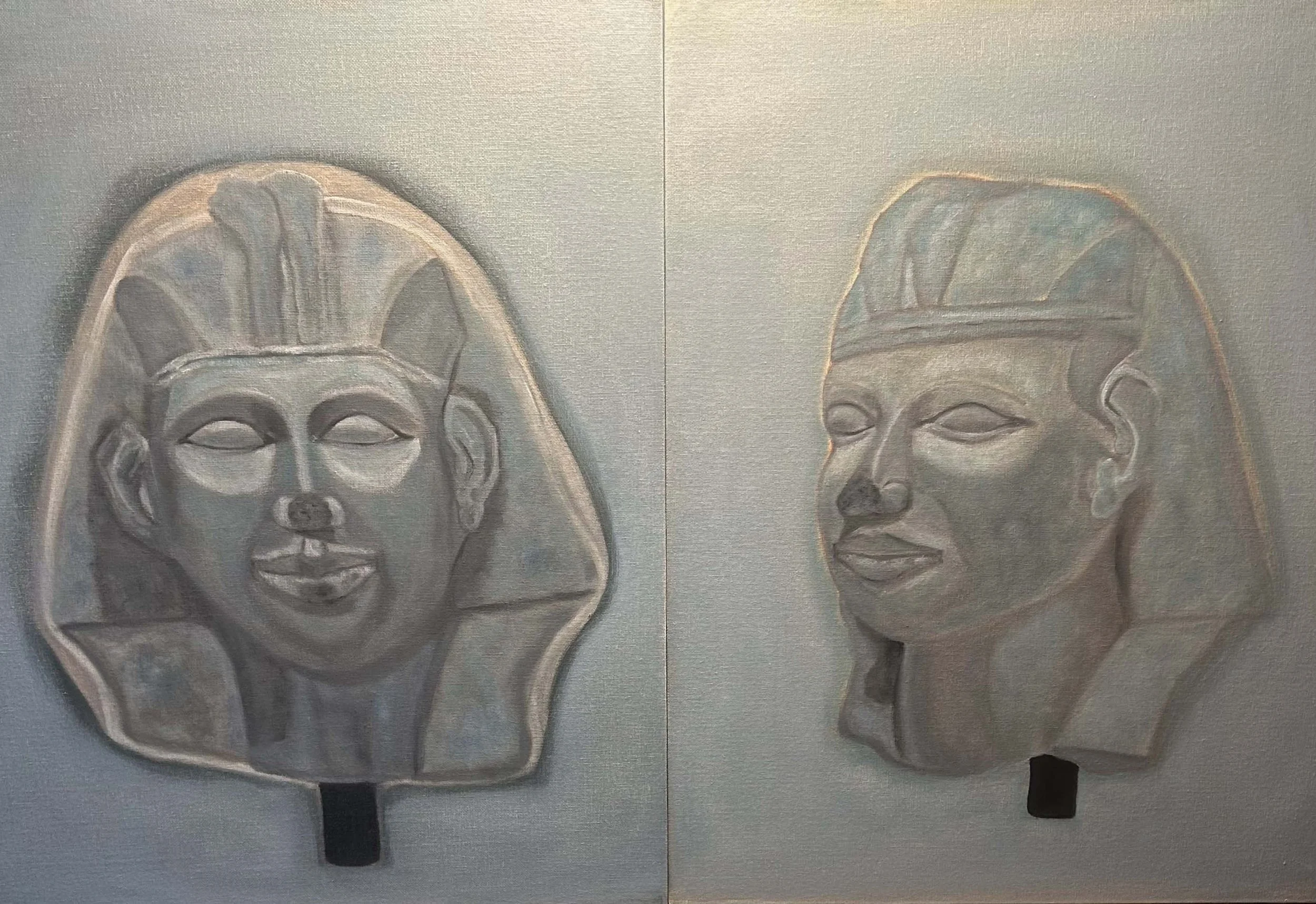
The Kushite kings came from an ancient kingdom in Nubia, centred along the Nile valley, in what is now Northern Sudan and Southern Egypt.
The Kushite Kings ruled in upper Egypt from 744 – 656 BCE:

This work is of three images of African women selected from a collection of photographs of African sculptures.
I choose the monochrome palette in order to place the focus on the womens’ decorative body and facial adornments.
Compositionally, I juxtaposed the African women enclosed by the Greek columns, because of the connection between European and African history

This portrait of an Abyssinian girl comes from a postcard sent to me from Addis Abba, by a humanitarian aid worker, some twenty years ago.
The postcard image is in monochrome which I replicated in my palette. I added the rich, deep red/brown background, to invoke the nature of the African environment.

This work is inspired by contemporary and traditional African art.
This traditional African artefact is of a ‘A Kongo Figure.’ The figure was carved from wood and is made by the Kongo people, who, from the 13th century, inhabited central west Africa.
The work was completed using a black and white photograph of the artefact. I chose the deep blue background to enhance the depiction of the monochrome figure, seated upon two dogs.

This is a Yaure mask from the Guro- Yaure region, in Sierra Leone. Masks from this region are carved out of wood and feature elongated faces, concave profiles and slanted eyes.
To bring into relief the facial features, I chose to use a brighter yellow/gold colour palette, than that found on the original mask.
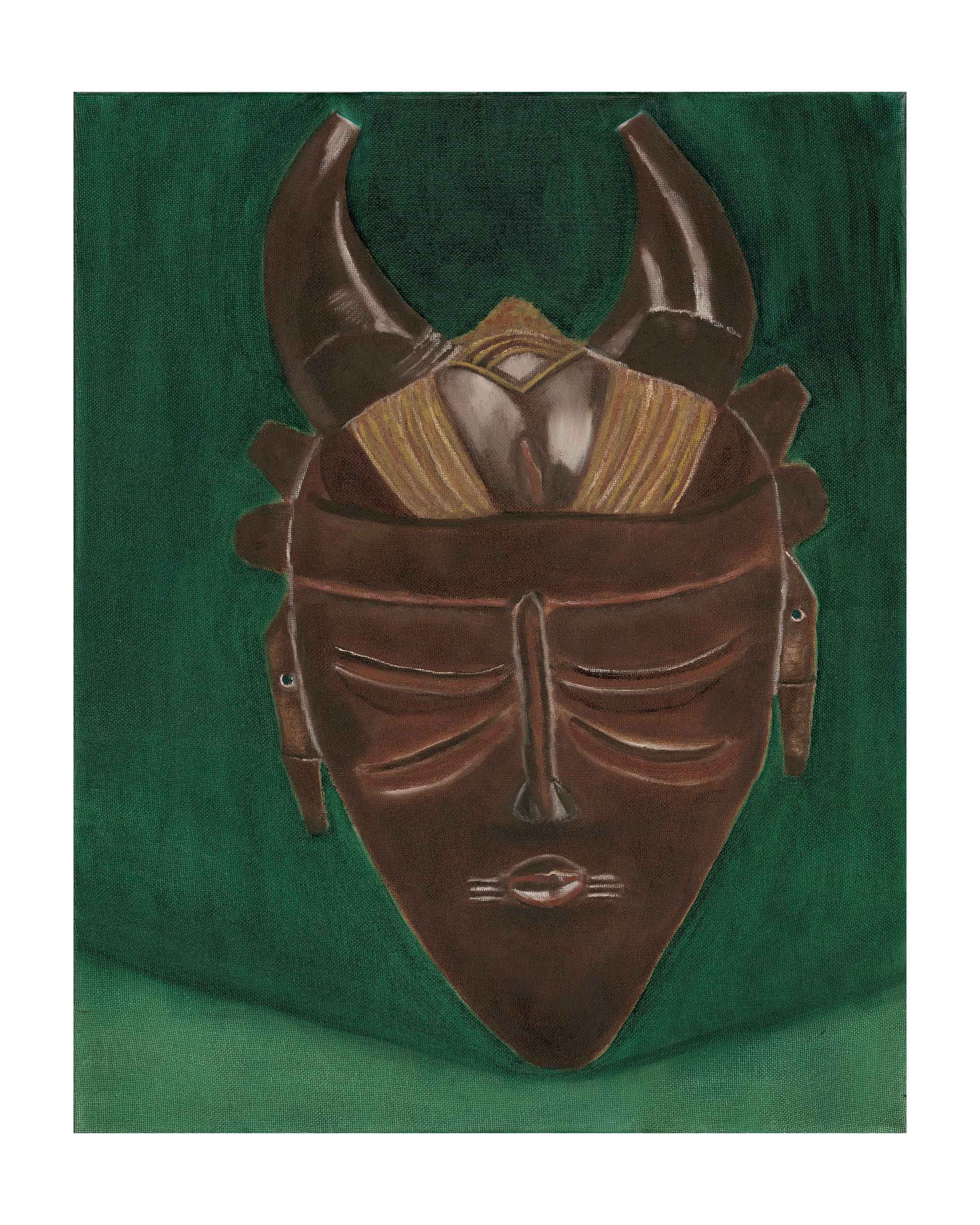
This is called a Ligbi mask, carved from wood and pigment.
The Ligbi people, who are related to the Senufo tribespeople, are a community originally from Ghana who now inhabit the Ivory Coast.
The typical Ligbi mask has an elongated face trimmed with wings on either side. The eyes are shaded and the mouth is rectangular. Both animal and human forms are combined in the mask image. Make-up and jewellery are also added to decorate Ligbi masks during the celebration.
For the palette, I choose to enhance the red tones in the wood and to set the mask against a dark green background.

This mask is from the Lobi-Mossi people, consisting of various tribes, who live across Burkina Faso, the Ivory coast and Ghana.
This is a Bobo mask, whose people live in the eastern Burkina Faso region. It is covered in a decorative geometric pattern and is worn during important communal ceremonies. These masks are set under horns, or as here, a huge crest symbolizing a bush animal.
The blue and orange colour palette I used is quite similar to the palette of the original mask.
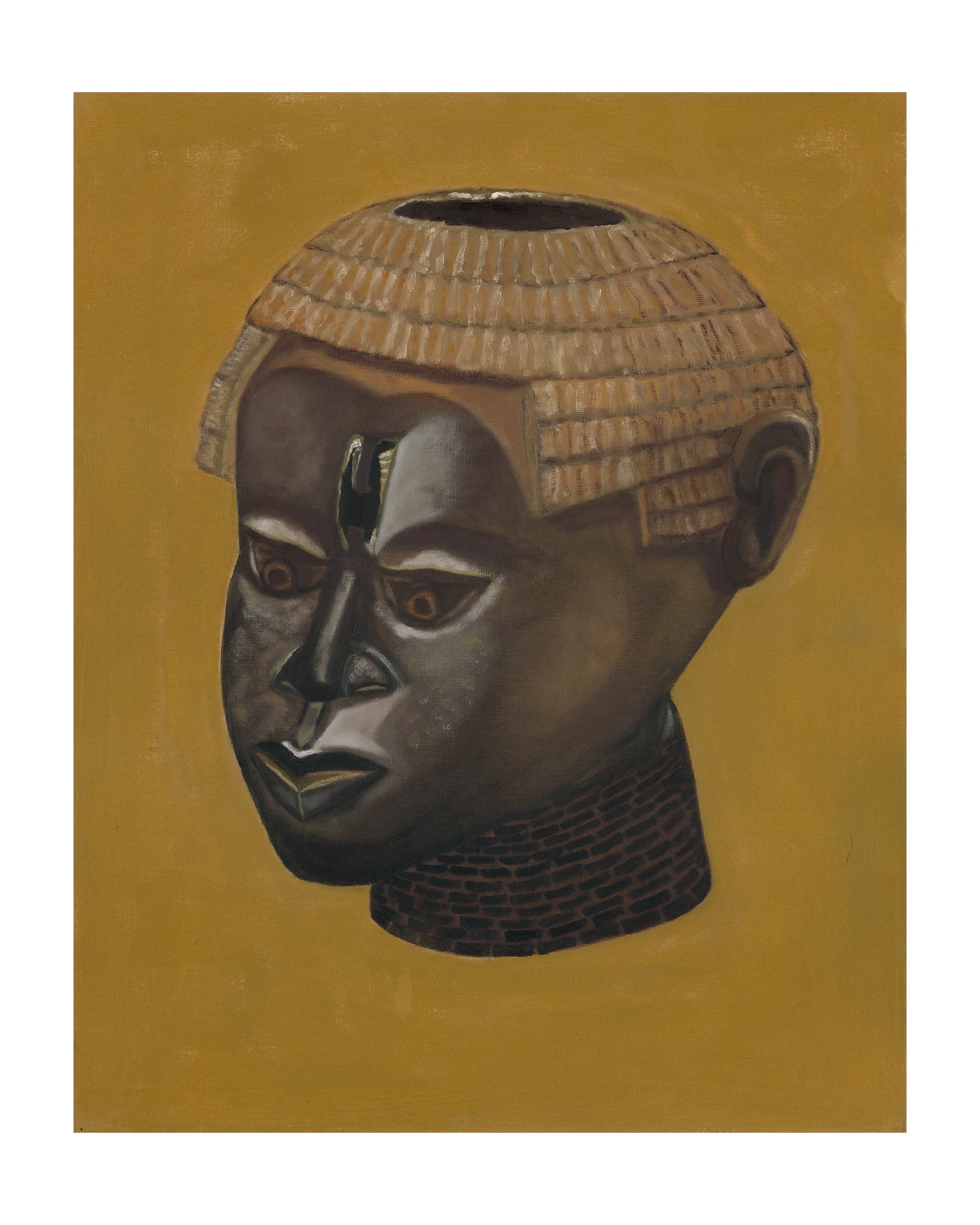
This work is inspired by my interest in African art and artefacts.
The Benin head is part of West African court art, created for Oba-King. The head was made of brass, in the 16th century.
The image of the head was taken from a photograph.
The colour palette was chosen to emulate the colour of brass and bronze, the materials associated with Benin artefacts.

This work was inspired by my interest in African art and artefacts.
The ‘Cihongo mask,’ symbolises wealth and power. It is a male mask, made from wood and vegetal fibres. It is attributed to the ‘Lunda people,’ who inhabited South West Africa, in the 15th century
For the palette, I have added many of my own colour choices to enhance the muted tones of the fabric of which it was made.

This work is inspired by my interest in African art and artefacts.
The Terracotta figure is attributed to the Mali empire, West Africa.
There were two major styles of Terracotta figures: Djenne and Bankoni. This figure is made in the Djenne style: with rounded features and facial scarifications. It dates from the 12th to 15th century.
The work was completed from a photograph. I used the deep red background to emulate the colour and texture of terracotta.

The original Oil on Canvas work is professionally Framed
It was completed from a monochrome photograph, of a headshot of a Maasai warrior wearing a ruff.
I devised my own color palette and added to the composition.
I used a palette of greens and blues and added the tunic to enhance the interesting juxtaposition between African and European dress.

The original Oil on Canvas work is professionally Framed.
I was inspired to paint this work, because it is one of the earliest, and the only portrait of a black African man, painted by a European artist, that has survived.
The original was painted around 1525 - 30, by the Dutch painter, Jan Mostaert.
The history of the sitter, who is finely dressed and almost certainly educated, is not confirmed. However, it is thought that he might have been a court attendant, at the Court of Magaret, or Charles V. The insignia on his hat alludes to possible Spanish or Portuguese origins.
The original portrait hangs in the Rijksmuseum, in Amsterdam.
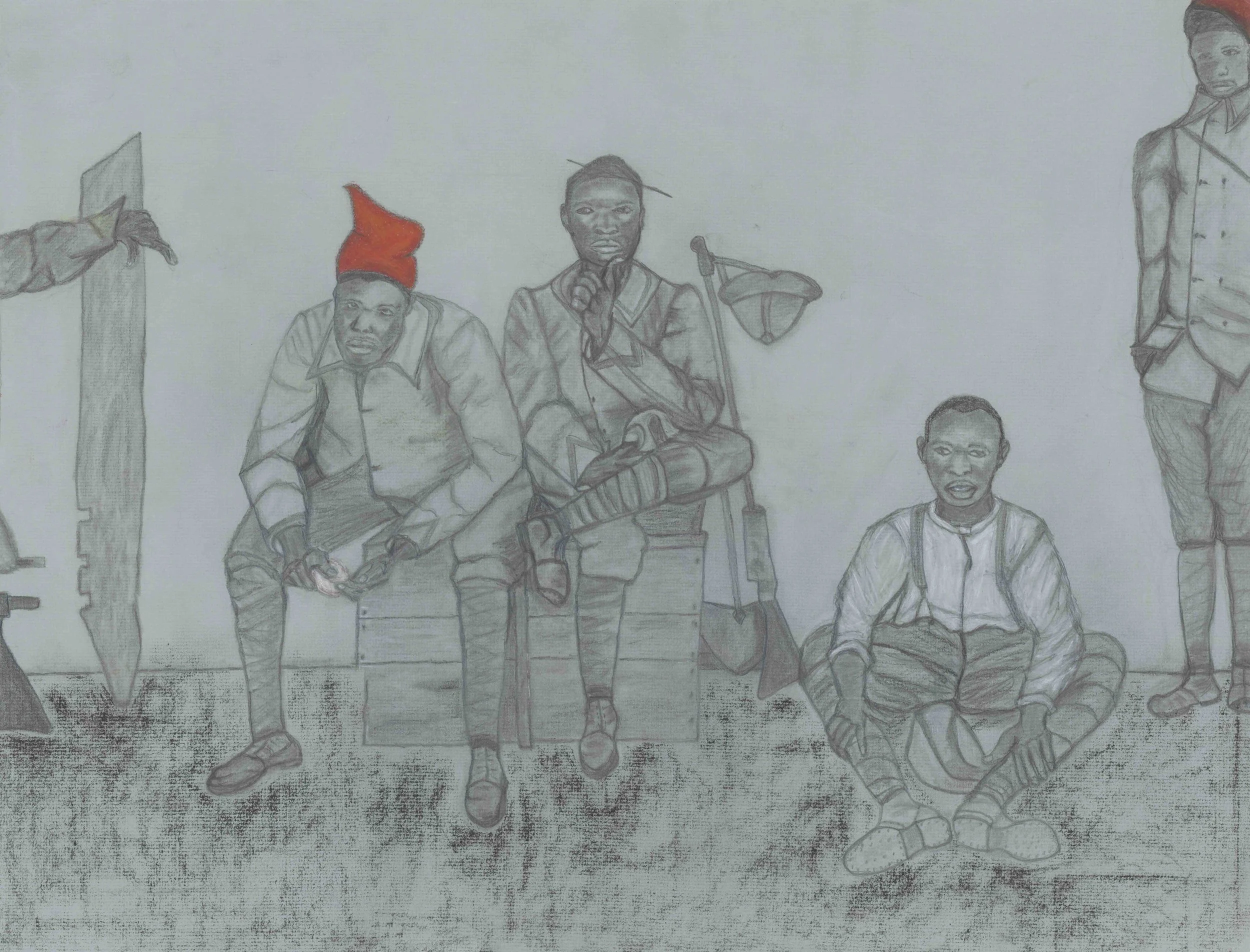
This work is a departure from my usual use of oil on canvas. Here I have used graphite and pastel (the red fez), on Strathmore paper.
The work is taken from a photograph of Senegalese riflemen soldiers during the First World War.
I was inspired to create this work by the story of how these soldiers were originally recruited by the French army.
When recruitment first began - mid 19th century - it depended on the slave trade. This meant that recruited soldiers were indentured for periods of up to fourteen years. Senegalese soldiers fought in key 19th and 20th century wars.
I found this work interesting, both as an artistic and historical piece. The story these soldiers have to tell, is etched upon their faces.

This original Oil on Canvas Polyptych, consisting of Four canvases, Titled: ID Entity, is Not For Sale (NFS) as a collection.
However the individual Artwork named “ID Entity 1” is for sale on its own - Professionally Framed
It is questioning the nature of Identity, particularly mixed heritage identity.
Please click through the carousel to see all images
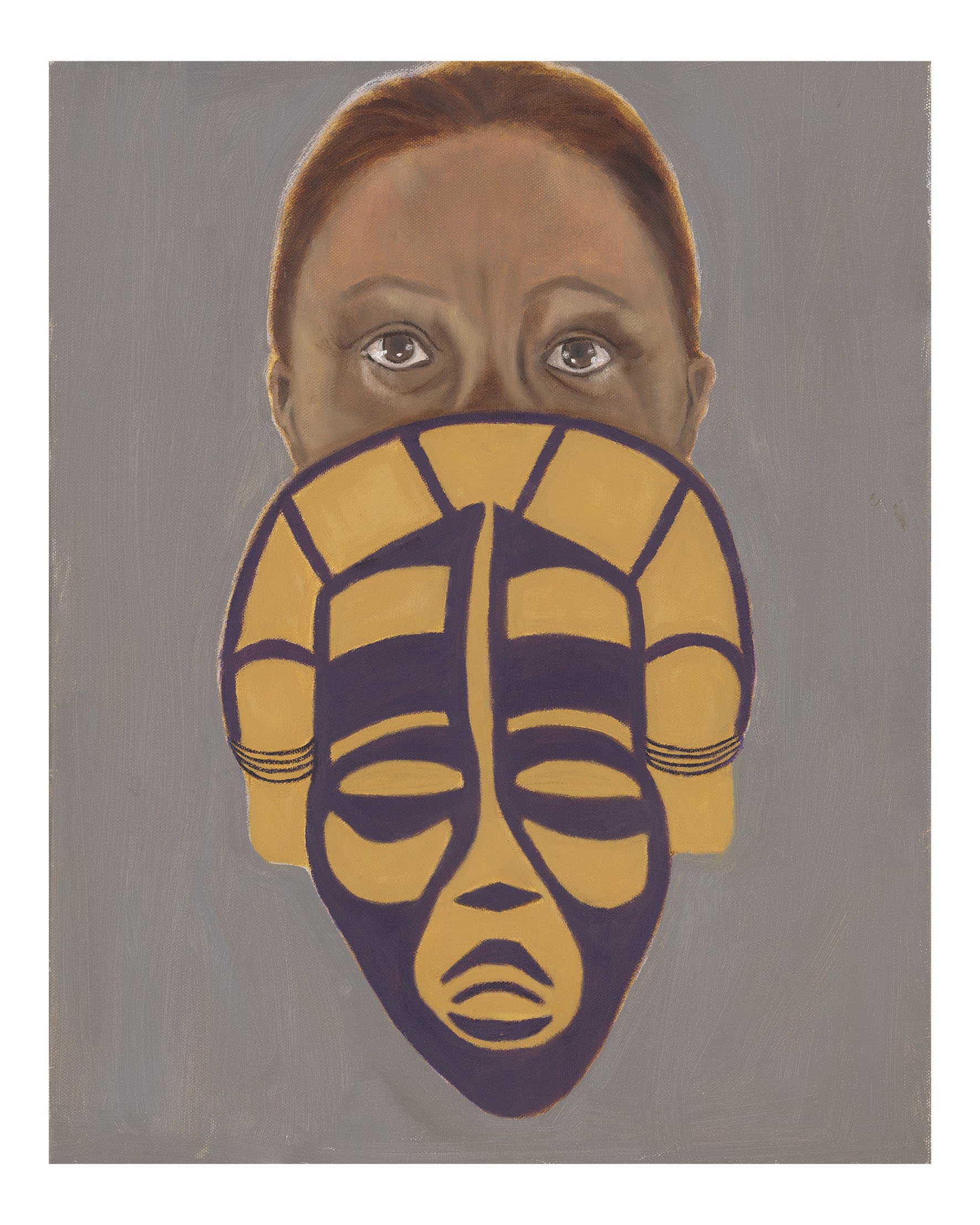
The original of this work has been SOLD, but prints are still available
This work is based on a photograph of a group of African women who are related to each other. These women married men who had immigrated from the Indian continent to Africa.
These women, together with others like them, were responsible for creating a new hybrid, African-Indian culture in South Africa and Zimbabwe.